What if the real risk isn’t failing to use artificial intelligence in your ISO 27001 approach, but using it without an adapted governance framework? AI is steadily making its way into GRC practice — risk analysis, documentation, audit preparation, action-plan follow-up — often with impressive time savings. But behind that productivity promise lies a question worth asking: are we producing compliance deliverables faster, or are we actually strengthening risk control?
- AI can genuinely accelerate risk analysis, ISMS documentation, audit preparation and Annex A follow-up.
- An ISMS generated quickly is not necessarily an ISMS that is actually controlled: a well-written document can mask a control that doesn’t exist.
- Using AI to secure your organization raises a new question: who secures and governs the use of AI itself?
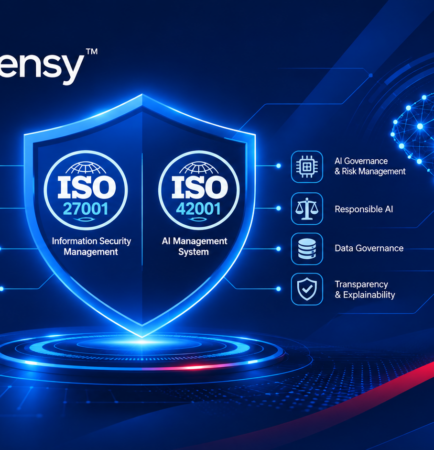
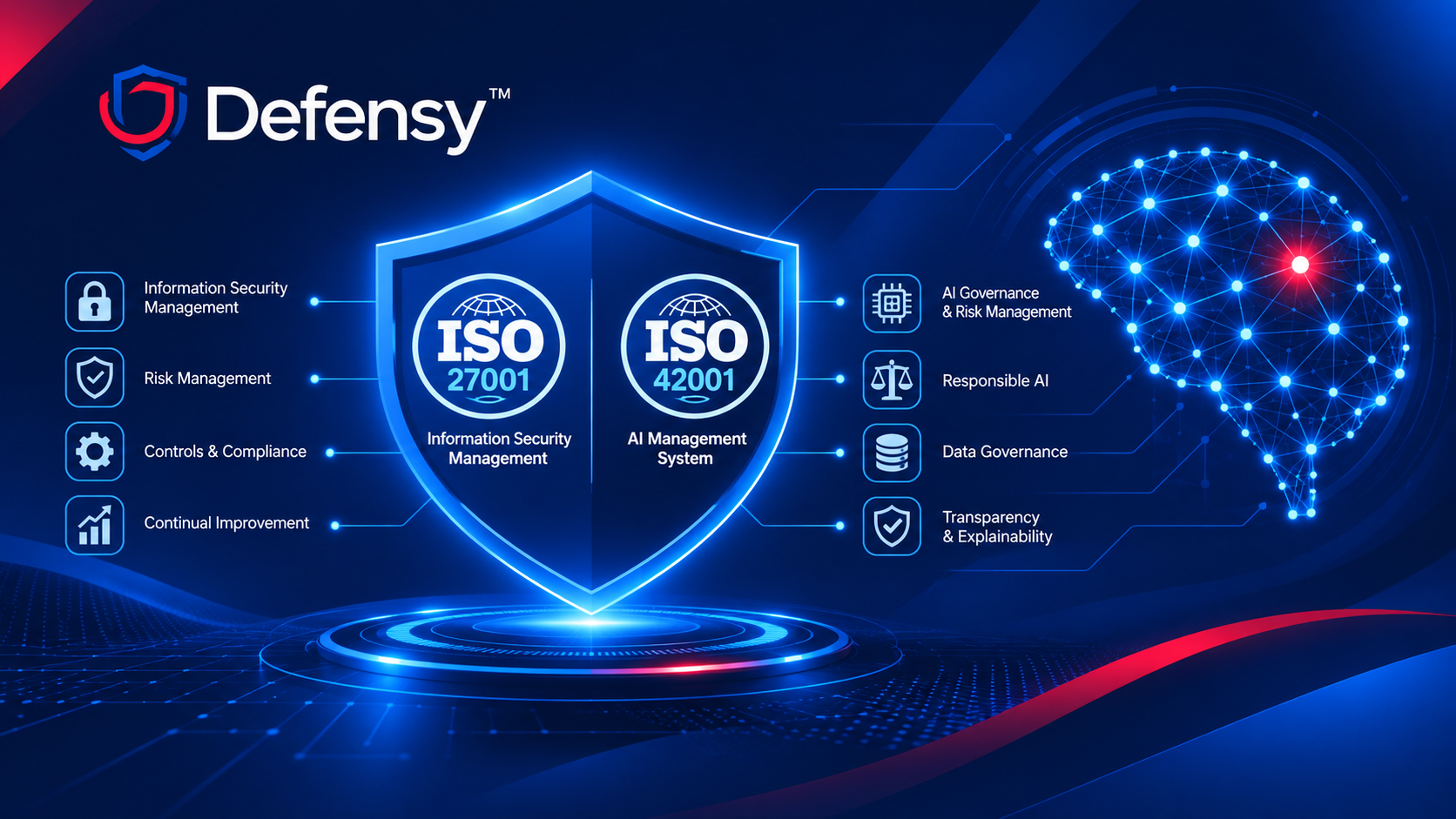
- ISO/IEC 42001:2023 provides an AI governance framework that complements ISO/IEC 27001, without multiplying standards for the sake of it.
AI as a genuine accelerator for your GRC approach
AI can today add real value across several ISMS-related activities: structuring risk scenarios and proposing treatment options, helping draft and update policies and procedures, helping build audit questionnaires and identify potential gaps, helping analyze Annex A controls and track their implementation, or designing awareness scenarios tailored to different employee profiles.
AI reduces certain repetitive tasks and frees up time for higher-value activities: analysis, advisory, support and decision-making. But producing faster doesn’t necessarily mean producing more accurately. And that is where the real challenge begins.
What we see in the field: when documented compliance doesn’t reflect reality
In GRC projects, one issue comes up repeatedly: the gap between what is formalized and what is actually applied. AI can widen that gap if its use isn’t sufficiently framed.
Imagine a company using an AI assistant to build its risk register, draft its security policies and prepare its Statement of Applicability (SoA). Within hours, it can obtain structured documents, complete tables and recommendations that look perfectly relevant. But behind this apparent maturity, several questions remain essential:
- Do the identified risks genuinely reflect the company’s activities, infrastructure and business stakes?
- Are the controls declared applicable actually implemented?
- Do the generated procedures match actual operational practice?
- Does the collected evidence genuinely demonstrate the effectiveness of security measures?
- Do business owners understand the decisions and commitments being formalized?
The paradox: we use AI to secure ourselves, but who secures its use?
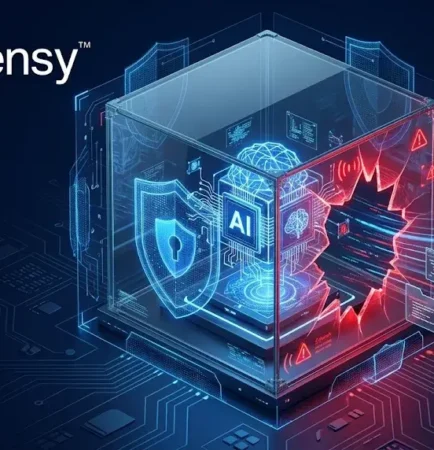
A company can use AI to strengthen its security posture while introducing new risks into its own environment. It is no longer just about protecting information, but also about controlling AI tools themselves — their uses, their outputs, their providers and the associated responsibilities. AI can become a security lever; without governance, it can also become a new risk vector.
ISO 42001: toward structured governance of artificial intelligence
This is where ISO/IEC 42001:2023 becomes relevant. It provides a management framework that helps organizations structure their AI governance and control the risks associated with AI systems. ISO 27001 and ISO 42001 don’t address exactly the same issues, but their approaches are complementary.
The goal isn’t to multiply frameworks or certifications. It is to build coherent governance that integrates information security and AI-related risk control within the same management dynamic. Securing the information used by AI is essential; governing AI systems is equally essential.
From experimentation to governance: what should organizations do?
Adopting AI shouldn’t be limited to authorizing the use of new tools. It must be accompanied by a genuine control framework.
Recommendations
- ImmediateMap your AI usage
Identify the tools in use, the users, the processes involved, the categories of data processed and the purposes pursued.
- ImmediateFormalize usage rules
Define authorized tools, what information may be shared, prohibited uses and validation procedures.
- Short termAssess AI-related risks
Analyze risks linked to confidentiality, reliability, bias, generation errors, vendor dependency and technology lock-in.
- Short termEstablish human oversight
Risk analyses, processing decisions, policies and recommendations generated by AI must be reviewed and validated by competent people.
- Medium termRaise awareness and accountability among staff
Users must understand the risks tied to their usage, the tools’ limitations and the responsibilities that fall on them.
- Medium termSet up continuous monitoring and improvement
Track usage, reassess risks, and adapt governance measures as technology and business needs evolve.
Tomorrow, what will be the real added value of the GRC consultant?
If AI can assist with drafting procedures, preparing analyses, structuring registers and automating certain tasks, the GRC consultant’s value will increasingly lie in the ability to understand the organization’s real context, challenge AI-generated results, identify risks that automated analysis misses, interpret regulatory requirements against actual context, and verify consistency between documents, controls and operational practice. AI can accelerate production; it replaces neither critical thinking, nor field experience, nor professional responsibility.
Artificial intelligence represents a major opportunity for organizations pursuing ISO 27001: it can speed up analysis, ease compliance activities and improve operational efficiency. But it also introduces new risks that require a structured, responsible approach adapted to each organization’s context.
Our Governance, Risk & Compliance offering and our ISMS & ISO 27001 support help your teams build a genuinely controlled compliance approach. Our Secure AI Adoption offering helps you govern your own use of artificial intelligence.